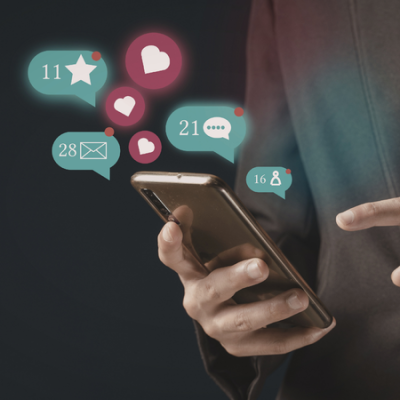

Ding! Someone liked your post. Ding! You have a new message. These familiar notifications
from the different social media platforms may often spark a small rush of excitement. What
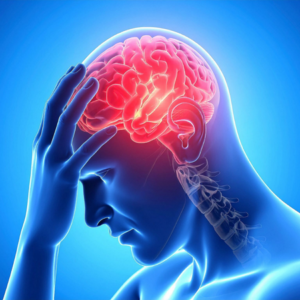
people might not know is that these alerts are doing more than just updating us—they trigger the release of dopamine in our brains, which is the reward system and creating a pleasurable sensation (UC Davis Health, 2024). Over time, this cycle can condition us to crave such interactions, reinforcing us to check for likes, comments, and shares. When these signals of approval are absent, however, the opposite effect may occur. Instead of pleasure, people may experience feelings of rejection, inadequacy, or self-doubt.
To better understand these dynamics, it is important to first define social media, then examine how it intersects with instant and delayed gratification. By doing so, we can better understand
the potential impacts social media has on mental health.
What is Social Media?
Social media refers to a collection of online platforms that allow individuals to interact, connect, and share content within digital networks (Bashir & Bhat, 2017). Examples include Facebook,
Instagram, TikTok, YouTube, and X (formerly Twitter).
Researchers define social media as a system that enables people to create, exchange, and engage with diverse forms of content such as messages, photos, videos, and articles (Ahmed, Ahmad, Ahmad, & Zakaria, 2019). It allows for individuals to maintain relationships, build communities, and share ideas regardless of distance.
However, while social media brings undeniable benefits in terms of connectivity and information-sharing, it also affects one’s mental health. The contents of these platforms are curated in such a way that triggers dopamine to be released and leads to instant gratification.
The Effects of Social Media?
The effects of social media are wide, influencing how people perceive themselves, interact with others, and make daily decisions. Many studies have highlighted both positive and negative outcomes. On one hand, social media can support mental health by providing access to social support networks, educational resources, and opportunities for creative self-expression. On the other hand, its design and constant availability may foster dependency and compulsive use.
A central reason why social media feels so compelling is its connection to dopamine. Dopamine is a neurotransmitter that plays a key role in motivation, learning, and reward-seeking behavior. Each “like,” comment, or share triggers a small dopamine release, producing a sense of satisfaction called instant gratification (Flex, 2023). Over time, this repeated reinforcement conditions users to continue engaging, hoping for the next rewarding interaction.
The danger is that this process can lead to an endless cycle of checking, posting, and seeking validation (Flex, 2023). Users may start to measure their self-worth by online approval, making them more vulnerable to negative emotions when engagement is low.
Instant Gratification
Going deeper, what is Instant gratification? This refers to the tendency to prefer immediate rewards over larger but delayed benefits (Goldfield, 2025). In the context of social media, this increases the temptation of instant gratification by offering continuous and easy access to small rewards. This desire for instant gratification affects a person’s decision-making process, creating the choice between immediate pleasures and future benefits (Yin & Shen, 2024). Given the age of social media and technology, most individuals tend to go for fast paced rewards. What makes social media more concerning is that it presents an endless supply of these rewards, making it difficult to exercise restraint.
Effects of Instant Gratification
When people consistently prioritize immediate rewards, several consequences can arise. First, people tend to become more impulsive (Flex, 2023). Rather than taking time to weigh long-term benefits, individuals may opt for “quick fixes.” A person might find it increasingly difficult to resist urges, leading to habits like compulsive scrolling or checking phones at inappropriate times. In some cases, this can escalate into problematic use, where social media begins to interfere with sleep, productivity, or face-to-face relationships.
Second are the emotional effects where individuals who rely heavily on social media for validation may become more vulnerable to mood swings, irritability, or even anger when the desired engagement fails to appear (Flex, 2023). Over time, this lack of emotional regulation can contribute to stress and dissatisfaction.
Social Media as a Source of Instant Gratification (UC Davis Health, 2024).
Social media is uniquely positioned to fuel instant gratification because of its design. Platforms employ algorithms that deliver personalized and fast-paced content, maximizing user engagement. Some of the main features that encourage this gratification include:
- Likes, Shares, and Comments: These act as immediate markers of approval, giving users a sense of recognition and belonging.
- Messages and Notifications: Alerts about direct messages or mentions increase feelings of connectedness, providing social reassurance.
- Short-form Content (e.g., TikTok, Instagram Reels, YouTube Shorts): Quick, entertaining videos deliver immediate stimulation and are often consumed in rapid succession.
While these features are not harmful in isolation, prolonged use may contribute to a range of negative effects, such as (Naslund, et. al., 2020).:
- Fear of Missing Out (FOMO)
- Social comparison and envy
- Burnout and fatigue from constant engagement
- Sleep disruption due to late-night scrolling
- Anxiety and depression linked to validation-seeking
- Exposure to cyberbullying and online harassment
- Strained offline relationships
- Dissatisfaction with body image
These outcomes underscore the importance of learning to balance the use of social media.
Promoting Delayed Gratification in Social Media Use
While social media is not inherently bad, its impact depends on how it is used. Like many tools, it can be beneficial when approached with moderation and harmful when consumed excessively. Some ways to counteract the pull of instant gratification is by intentionally cultivating delayed gratification.
Here are some ways which one can promote delayed gratification in terms of social media use:
- Slowing Down and Taking Breaks
Pausing from social media creates mental space to reflect on habits and choices. Breaks can weaken the automatic cycle of checking for notifications and allow individuals to re-engage with
activities that provide long-term satisfaction. - Setting Social Media Boundaries
Boundaries can include time limits, app restrictions, or “tech free” hours during the day. By reducing availability, users can protect their focus and emotional well-being. - Limiting Short-form Content
Choosing to consume longer forms of media—such as articles, documentaries, or podcasts—can help retrain attention spans and reduce reliance on constant novelty. - Practicing Mindfulness
Mindfulness involves cultivating present-moment awareness without judgment. When applied to social media, mindfulness helps individuals notice urges, reflect on whether to act on them, and engage more intentionally. Over time, this increases self-control and reduces dependency on dopamine-driven reinforcement (Flex, 2023).
Social media has transformed human interaction, offering opportunities for connection, entertainment, and knowledge sharing. At the same time, it poses risks of dependency on instant gratification. The dopamine-driven cycle of likes, comments, and short-form content can fuel impulsivity, emotional instability, and even mental health struggles.
Yet, social media itself is not the enemy—it is our relationship with it that determines its impact. By slowing down, setting boundaries, choosing more mindful forms of engagement, and practicing delayed gratification, individuals can enjoy the benefits of social media while safeguarding their wellbeing. In doing so, we shift from being passive consumers of digital validation to intentional consumers.
References:
- Bashir, H., & Bhat, S. A. (2017). Effects of social media on mental health: A review. International Journal of Indian Psychology, 4(3), 125-131.
- Flex, A. (2023, July 5). The rise of instant gratification culture: How smartphones and social media contribute. Medium. https://medium.com/@neonmaxima/the-rise-of-instant-gratification-culture-how-smartphones-and-social-media-contribute-33bfa3a43ab4
- Goldfield, G. (2025, March 4). I want it now! The psychology of instant gratification. Psychology Today. https://www.psychologytoday.com/us/blog/no-more-fomo/202503/i-want-it-now-the-psychology-of-instant-gratification
- Naslund, J. A., Bondre, A., Torous, J., & Aschbrenner, K. A. (2020). Social media and mental health: benefits, risks, and opportunities for research and practice. Journal of technology in behavioral science, 5(3), 245-257.
- Sadagheyani, H. E., & Tatari, F. (2021). Investigating the role of social media on mental health. UC Davis Health. (2024, May 10). Social media’s impact on our mental health and tips to use it safely. Cultivating Health. https://health.ucdavis.edu/blog/cultivating-health/social-medias-impact-our-mental-health-and-tips-to-use-it-safely/2024/05
- Yin, B., & Shen, Y. (2024). Development and validation of the compensatory belief scale for the internet instant gratification behavior. Heliyon, 10(1).