
Categories
General

One Treasure

“You are the One treasure, so you need to come to know who you really are.” 

-Sr. Rosario Battung, RGS,  Zen Teacher and Social Activist

In a few days, we will be pausing in observance of the culmination of the Lenten season. Although a Catholic tradition, the Holy Week holiday can provide everyone, even those not religiously affiliated, a much-needed opportunity to take a step back and gain a grounding perspective in life.

Spirituality is one of the key dimensions to holistic wellbeing, and one’s spiritual experience does not have to be tied up with organized religion.

In a broader sense, as defined in the Wheel of Wellbeing  (Sadigh & Sadigh, 2008),  spirituality can be understood as “a sense of connection to something bigger than ourselves, and a source greater than the material world.  It means discovering the essence of our being and our deepest values by which we live by. It is the quest for finding the meaning of life and our life purpose.”  Living with a deeper why is vital to our resilience. It gives us the courage, clarity, and determination to withstand the turbulent forces of change and adversity which will always be part of human life. 

As we enter this period of sacred pause and reflection, allow me to share a deeply inspiring teaching from my Zen teacher, Sr. Rosario Battung. Sr. Rosario (Chayong as she was fondly called) lived an extraordinary life as a Catholic nun, a Zen practitioner for over four decades, and a social activist whose life became the inspiration for the critically-acclaimed Filipino film Sister Stella L. We had a private interview a few months before she passed away as is customary for teacher and student in Zen practice. At that moment, I knew that I was receiving an exquisite and very profound teaching, which I immediately transcribed in my journal. Little did I know that these were to be her “final instructions.”  Her message has become more and more special each time I came home to it– alive and constantly reaching into my soul.  It is my honor and joy to share with you the words of Sr. Rosario. I am sure you will find that it speaks to each and every human heart.

It is essential to know the art of paying full attention to yourself because it is this Self that reaches out to others. No one benefits when you put yourself aside. Instead, you need to be your full Self. The one responding needs to be full. We’re always on-the-go helping others, but we’re not doing justice to others and to ourselves unless we’re paying full attention to ourselves. 

The bell of the present moment calls your name. Hold the horses and ask yourself, what is the main thing? Who is holding the reins of this present moment? What is at the heart of now? Face yourself and know what it is you need to be attending to.   

Make space in your life to experience your True Self. It will tell you who you really are. You are distracted by helping others and set aside your innate Self. You think something else is more important other than your True Self.    

There is one treasure hidden in one body. You are the One Treasure, so you need to come to know  who you really are. Give your full attention to that One Treasure. Celebrate it with joy, your True Self is present. 

One Treasure: An Invitation to Pause and Reflect

  1. When have I experienced myself as the One Treasure? What did these moments feel like? What conditions made it possible for me to experience myself in this way?
  2. In my everyday life, what gets in the way of experiencing the One Treasure, my full Self? What “horses” are preventing me from coming home to the present moment with my full Self?
  3. What is one commitment that I could make to honor and discover this One Treasure?

Categories
Blog Everyday Thriving

COVID-19 and the Crisis of Happiness: Knowing what we are (not) responsible for

With COVID-19 restrictions in public life easing, there is an excitement for a return to “happiness.” The desire surely comes from intense feelings. Many of us struggled to meet our daily needs, endured prolonged states of helplessness, faced sickness or death every other week, and confronted deep-seated hurts and longings which we only managed to avoid through the daily routines the pandemic stole away. And yet somehow, according to the latest World Happiness Report, the Philippines ranked 60 out of 146 countries in levels of happiness in terms of overall life evaluation.1 How is this so? And what can this experience of a global health crisis offer in our ongoing struggles to recreate and reimagine happiness?

Drawing from our clinical work, this article will briefly look at discerning the factors we can exercise responsibility over, and what questions we can ask ourselves to exercise “psychological flexibility” in response to these feelings of accountability and helplessness.

Not every variable affecting happiness is our responsibility. While this fact does not imply a disregard of personal liability, a fuller experience of happiness requires that this sense of responsibility be exercised with restraint. This can be done through the practice of “psychological flexibility”, and we offer two basic questions to start. First, are you actually responsible for the things you hold yourself responsible for? And second, can you be kinder to yourself for what you are actually responsible for?

Not every variable affecting happiness is our responsibility.

Consider three of the six general predictors used by the World Happiness Report: “social support”, “perception of corruption”, and “Gross Domestic Product (GDP) per capita”. 2What you notice almost immediately is that these factors affecting happiness have little to do with individual willpower. For example, a person’s ability to access social support can be affected by cultural environments that create “social handicaps” (i.e. anything from a person’s physical and psychiatric disabilities to their membership in a stigmatized group which communities consciously or implicitly act upon in ways which impair a person’s ability to access goods, services, or privileges).3 Similarly, how rampant corruption is or how high the average household income might be is grounded in systemic issues of policy and governance rather than simple personal will. Other predictors alluding to personal decisions, such as “generosity”, “healthy life expectancy”, and “freedom to make life choices”, are influenced by things outside the conscientious exercise of personal agency. Our decision to donate to a cause might be affected by something as arbitrary as gender norms or whether you are told someone else gave a donation.4 You may be predisposed to chronic illnesses regardless of how hard you try to stay healthy.5 The choices we are “free” can hardly be called “free”, such as when systemic discrimination on the basis of sexual orientation or gender identity creates barriers to “choosing” to seek out healthcare services.6 There are other examples, but the fact that these were the variables used by a major global study tells us something about to what extent we can claim responsibility for the happiness we feel at any given time.

None of this implies a disregard of personal liability, and it is still true that we must exercise accountability for our choices. Accountability to legitimate social expectations (e.g. others expecting you not to steal from them) and to personal principles (e.g. valuing honesty) is critical not only to a functioning society but to living authentically. Having a sense of responsibility over our lives means we can exert influence over our lives, and by extension flourish in ways that are authentically ours – a capacity that is essential to happiness.7 But not everything is your responsibility. Contracting the COVID-19 virus can happen no matter how cautious you are. Being stuck in homes that hurt you because of quarantine restrictions, and the lack of feasible alternatives, is often more about circumstances outside your control. Sticking to a job that is making you sick is still less risky than seeking a new job elsewhere, especially when even short-term joblessness puts you and your dependents at so much risk. Happiness requires that this sensibility be exercised with restraint – and this, at least, we can always do.

Psychological flexibility is a key variable to happiness.

What does “exercising restraint” look like? This starts with discerning what is and isn’t within our control.

It means identifying what we can reasonably be accountable for, a part of a lifelong effort of balancing between our desire to live authentically and the reality of living in contexts of less-than-ideal choices.

This balance is achieved, among other things, by what is called “psychological flexibility”. In the most basic sense, this means “the ability to adapt in response to changes in external or internal circumstances”.8 It has been rightly called “a fundamental aspect of health” and involves a process where a person “adapts to fluctuating situational demands … reconfigures mental resources … shifts perspective … [and] balances competing desires, needs, and life domains.”9 Here, this means allowing for more nuance in understanding and implementing our sense of responsibility in situations fraught with ambiguity. We can start with two questions.

1. Are you actually responsible for the things you hold yourself accountable?

We have all had to face disturbing situations. To use a personal experience, it may have been losing a loved one to COVID-19. You may believe you did not get them the care they needed in time, or could not get them care at all because you had no means to do so. True, what they received may have been too little or too late. But to indulge in self-blame is problematic in at least three ways. First, it assumes that their wellbeing was your sole responsibility. Contributing to another’s wellbeing is not the same as taking ownership of their wellbeing. Second, it assumes that the failure is your own. As a public health issue, this cannot be stressed enough: our social institutions are governed along the system of the nation-state, and things such as providing comprehensive healthcare is the obligation of the state and not of any one person. Third, the blame assumes that you should have been better prepared. Speaking again from personal experience, there is no way to adequately prepare for something like this, not financially (given the country’s serious problems with labor and privatized healthcare) and certainly not emotionally. It is true they didn’t receive the care they needed. But it is equally true that it wasn’t entirely yours to give.

The blame can be subtler. You may blame yourself for failing in a career task, or some personal goal. Maybe you were unable to maintain important bonds, like a romantic partner. Anyway, the underlying assumptions are the same. You may be taking ownership for something that isn’t yours alone. Relationships, for example, evidently involve more than one person, and responsibility is shared as such. You may believe that the failure of the situation was entirely on you. Within businesses and organizations, there is actually only so much an individual can rightfully be held responsible for: an individual’s failure to complete can also be an organization’s failure to consider what a task really entails under these extraordinary circumstances. Or you may believe that you could have prepared more. While that might be true, remember that hindsight is 20-20, and also that the psychological strain of a global crisis has had a real effect on the decisions we made.10

2. Can you be kinder to yourself for not succeeding in what you were responsible for?

Strange as it sounds, it is easier to blame ourselves. Personal failure assumes the possibility of its opposite: personal success. If only the circumstances were different! There is some pleasure in considering alternative outcomes where you come out with a strong finish. But that pleasure is not the same as happiness. The circumstances were as they were; it can never be anything other than what it was. More fundamentally, it is difficult to accept that such a “success”, however we envisioned it, was not possible given what you had and what you knew at the time. Not finishing strong, and barely making it, may have been the only logical outcome. It may have even been the best outcome, as even bigger failures may have been more likely than even smaller successes. This is not a fun thing to realize.

Responding to a clear personal failure – the kind which not only cuts deep and could not have been anything else – is no small pleasure. But taking a position of kindness in response to these failures, called “self-compassion”, is fundamental to happiness.

So consider: can you be kinder to yourself for not living up to your expectations? Can you be kinder to yourself for not succeeding in what you were responsible for?

As we enter a phase which foresees an “end” to the pandemic’s sudden and major upheavals, it is important to exercise as much of this flexibility as possible, so we might carry with us a sense of our capacities unburdened by a sense of responsibility that is kinder and more understanding.

Sources:

  1. See Table 2.1 in Helliwell, J.H., Layard, R., Sachs, J.D., De Neve, J., Aknin, L.B., and Wang, S. (2022). World Happiness Report 2022. Sustainable Development Solutions Network. Retrieved from: https://worldhappiness.report/.
  2. Ibid
  3. Koukouli, S., Vlachonikolis, I. and Philalithis, A. (2002). Socio-demographic factors and self-reported funtional status: the significance of social support. In BMC Health Services Research, 2(20). DOI: 10.1186/1472-6963-2-20.
  4. Allen, S. (2018). The Science of Generosity. Great Good Science Center, UC Berkeley. Retrieved from:  https://ggsc.berkeley.edu/images/uploads/GGSC-JTF_White_Paper-Generosity-FINAL.pdf.
  5. Wehby, G.L., Domingue, B.W., and Wolinsky, F.D. (2018). Genetic Risks for Chronic Conditions: Implications for Long-term Wellbeing. In Journals of Gerontology Series A: Biological Sciences and Medical Sciences, 73(4), 477-483. DOI: 10.1093/gerona/glx154.
  6.  See Subsection on “Barriers to Accessing Healthcare” in Chapter 2 of Institute of Medicine (US) Committee on Lesbian, Gay, Bisexual, and Transgender Health Issues and Research Gaps and Opportunities (2011). The Health of Lesbian, Gay, Bisexual, and Transgender People: Building a Foundation for Better Understanding. DOI: 10.17226/13128. Retrieved from: https://www.ncbi.nlm.nih.gov/books/NBK64806
  7.  Koydemir, S., Şimşek, Ö.F., Kuzgun, T.B., and Schütz, A. (2020). Feeling special, feeling happy: Authenticity mediates the relationship between sense of uniqueness and happiness. In Current Psychology, 39, 1589–1599. DOI: 10.1007/s12144-018-9865-z.
  8. Stange, J. P., Alloy, L. B., & Fresco, D. M. (2017). Inflexibility as a Vulnerability to Depression: A Systematic Qualitative Review. In Clinical psychology: a publication of the Division of Clinical Psychology of the American Psychological Association, 24(3), 245–276. DOI: 10.1111/cpsp.12201.
  9.  Kashdan, T. B., & Rottenberg, J. (2010). Psychological flexibility as a fundamental aspect of health. In Clinical Psychology Review, 30(7), 865–878. DOI: 10.1016/j.cpr.2010.03.001.
  10. Tarantino, V., Tasca, I., Giannetto, N., Mangano, G.R., Turriziani, P., and Oliveri, M. (2021). Impact of Perceived Stress and Immune Status on Decision-Making Abilities during COVID-19 Pandemic Lockdown. In Behavioral Sciences, 11(12), 167. DOI: 10.3390/bs11120167.
  11. Neff, K.D., Rude, S.S., and Kirkpatrick, K.L. (2007). An examination of self-compassion in relation to positive psychological functioning and personality traits. In Journal of Research in Personality, 41, 908-916. DOI: 10.1016/j.jrp.2006.08.002.


Categories
Blog Everyday Thriving

Making Space for Me: Gifting Ourselves with a Deep Reset this Holiday Season

We bade 2020 with a jubilant good-bye perhaps not realizing how 2021 would present even greater challenges and disruptions in our fight against Covid-19. Those of us who continued to work from home have struggled with blurred work-life boundaries, leading to stress and exhaustion, for some even burnout. We had to endure another year of limited face-to-face contact with our friends and co-workers, which has led to deeper feelings of isolation and loneliness. Parents working from home have to make it through the daily hurdles of managing family life along with increased work demands.  A Harvard Business Review survey among 1500 workers in 46 countries found that 85% reported a decline in their general wellbeing since the start of Covid-19. Survey respondents cited mental health decline, increased job demands, basic physical needs, home-life struggles, and isolation, and disengagement from work as some of the top contributors to this drop in wellbeing. In light of these pressing realities, self-care practice has become a daily necessity in order to facilitate stress recovery and prevent physical and mental illness.  

As the year ends and we begin to down-shift  into the holiday season, we should not lose sight of the opportunity we have to pause and provide ourselves the space and time for a deep reset. Many of us have probably become all too familiar with living on overdrive and powering through to get things done. We want to be a person that others can rely on, to be seen as competent,  and make a significant contribution to the endeavors we are a part of. However, neglecting our need for replenishment, not taking our wellbeing seriously, can work against our aspirations to grow and thrive. We can ask ourselves, do I just want to keep my motor going frantically on high speed until my tank runs empty and breaks down, or can I drive at a safe speed and allow myself moments of stopping and filling-up so that I can enjoy the ride? The choice is ours to make. And as we contemplate on  this question, we can take inspiration from beloved poet, Mary Oliver, reminding us of what it means “to go easy” on ourselves.     

When I am Among the Trees

Mary Oliver

When I am among the trees,
especially the willows and the honey locust,
equally the beech, the oaks and the pines,
they give off such hints of gladness.
I would almost say that they save me, and daily.

I am so distant from the hope of myself,
in which I have goodness, and discernment,
and never hurry through the world
but walk slowly, and bow often.

Around me the trees stir in their leaves
and call out, “Stay awhile.”
The light flows from their branches.

And they call again, “It’s simple,” they say,
“and you too have come
into the world to do this, to go easy, to be filled
with light, and to shine.”

Going easy on ourselves does not mean complacency and not taking responsibility. It means making space for Me to connect with my best self, with the goodness and light that allows us to give from the wise and compassionate center that is in each one of us. It is not only for ourselves that we need to go easy. It is also for the people we love and care about because constantly hurrying through the world makes it impossible for us to truly pay attention and be present.  

Author and meditation teacher, Larry Ward, said, “We need to design our life so we can wake-up.” Making space for Me this holiday break and beyond means making time in our life to “walk among trees”—that is, to experience the voluntary simplicity of slow and quiet moments that are so essential to the process of growing and becoming whole. We can design our life so that we can wake up from the trance of getting stuck with mindless doing. This holiday season, we can give ourselves the gift of a deep reset, fostering recovery and healing for our mind, body, and spirit so that we can step into the next year feeling renewed from the inside out.

Ways to Get Into a Deep Reset this Holiday Break

1. Unplug

Give yourself at least a few days to completely unplug from work. Stow-away your laptop, turn off notifications on your devices, and give yourself a break from incessantly checking text messages. Our habits of constant busyness and stimulation can tax our nervous systems, leading to chronic stress. Unplugging means stepping out of the stress reactivity cycle, giving ourselves room to rest and restore our energy.

2. Play

According to Irish playwright George Bernard Shaw, “We don’t stop playing because we grow old, we grow old because we stop playing.”  Play is a very rejuvenating experience that needs to be part of our life regardless of age. Being in play mode fosters the nervous system’s relaxation response and allows us to release emotional and physical tension. Engaging in play cultivates our creativity, which includes the ability to see new perspectives or approach problems from a unique angle. We can play by making time to fully enjoy a hobby, doing something that doesn’t require “efforting”, or jumping into having fun with others and letting go of worries even for a moment. 

3. Connect

Human beings are hard-wired for connection. Experiencing positive and meaningful connection both with ourselves and others is deeply restorative. This holiday break, make time for attentive and warm conversations, plan to have ample time to be with a loved one or someone whose presence gives you joy, connect with nature by taking a quiet walk or hike in a place where you can enjoy nature views. 

4. Reflect

The practice of reflecting is a way of looking into ourselves and our experiences from a place of genuine curiosity, openness, and kindness. It’s not about picking on our mistakes or hyper-focusing on our weaknesses. Reflecting can be our way of inviting ourselves into a space of gratefulness, stopping to appreciate all the conditions of happiness that are in our life that we tend to lose sight of when we are too busy. It can also mean allowing ourselves to quiet our minds to be clearer about what truly matters to us. We can reflect by journaling, reading books or listening to podcasts that inspire and deepen our hope, and by participating in online retreats.

Categories
Blog Everyday Thriving Restorative Practices Wellbeing Practices

Wellbeing Begins with Pausing

Many of us have been running all our lives. Practice stopping. 

Thich Nhat Hanh, Zen Master 

I find myself writing this article at the end of a five-day total voice rest, part of my physician’s prescription to address throat problems which have been affecting me lately. Although the prescription came along with some medication, my wise doctor cautioned, it will not work without resting. That conversation landed on me with a very mixed bag of thoughts and feelings. There was worry, “Will I be ok? Will this treatment work? How will I do this when I’m scheduled for at least a couple of months ahead?” I remember shame and self-judgment being present too, “How could I have let this happen to myself? The inner self-talk jumped in on the chatter with self-blame, “I’m a mental health professional, I should have known how to take better care of myself. I should be better at practicing what I teach.” And yet, on the other side of the worry and self-criticism, I felt relief and freedom, even joy, at the thought of an unplanned rest. This is what’s in my heart that I’ve really wanted but have not had enough courage to do without “justification.” As I let the inner whirling slow down and the sediments of my thoughts and emotions gradually settled, I started to feel a sense of gratitude that life is patiently and lovingly teaching me once again–pausing is a pre-condition for healing and wellbeing.

I love long breaks. I’ve always cherished being able to take two to three weeks off from work and getting a deep system reset. But while these have worked very well for me, I’m learning more and more that cultivating wellbeing is really about embracing the habit of pausing and slowing down in our everyday life, mindfully weaving it into the fiber of our moment-to-moment existence. Pausing and resting are not supposed to be merely an appendix to our busy and over-scheduled lives. We know from how the human nervous system functions that having the discipline to pause is necessary in sustaining a generative and meaningful life.

Without pausing, our stress levels rise, we start living on survival mode and stray away from living in our zone of resilience where we can be our wisest and most skillful self.

Ultimately, cumulative micro-pauses, can do more for our wellbeing than sporadic long breaks. The essential turning point in establishing the pause practice is being able to transform our way of seeing and understanding—that making space for being is not separate from our doing. Our actions, projects, and goals are enhanced, not threatened, by pausing. 

“Design your life so you have time to wake up.”

Dr. Larry Ward, Spiritual Teacher

Waking-up means being able to pay attention, be present, think clearly and creatively, and live from our place of deepest potential. This is opposed to being on auto-pilot mode, in which we are stuck in a habit loop of constant doing, activity, and distraction.  We can re-design our life to embrace micro-pauses and be more intentional in stopping for simple moments of rest. Stop, take a moment to review your day from the moment you awaken in the morning to the time you go to bed, what micro-pauses can you begin to incorporate throughout the day? Start with a few pause practices, particularly those that you can do consistently (you may try the ones below) and observe how it makes a difference in your life.

Ten Micro-Pauses for Everyday Life

  1. Instead of rushing out of bed in the morning, practice one minute of mindful breathing to start the day. This can be a powerful reminder that you always have a choice not to be carried away by habits of mindlessness.
  2. Pause for an intention. Before getting out of bed, ask yourself, what is one thing that can make this day truly worthwhile?
  3. Take your morning shower without running the day’s agenda through your head. Make this a moment to refresh your body and mind. 
  4. Take a few seconds to savor the taste and aroma of your first sip of coffee in the morning or simple open your senses to that first sip of water and how it nourishes your body.    
  5. Before opening your email or checking messages on your phone, stop, remind yourself that you control these devices and not the other way around. Throughout the day, practice pausing before reaching out for your phone to recognize that we don’t always have to fill our quiet moments by seeking for distraction. 
  6. Pause and stretch your body every couple of hours at work. Stretching gives your body the space to be acknowledged and relieved of tension, tightness, and pain that comes from sitting and working continuously. 
  7. Give yourself a sufficient lunch break so that you can eat mindfully, not rushing into a meeting or task. Mindful eating aids in healthy digestion and absorption of nutrients for your body and mind. 
  8. Stop to connect. Connect with yourself though a 3-center check in (What’s going on in my body? My emotions? My thoughts?). Connect with a co-worker by checking-in or talking about a non-work topic. Enjoy brief spontaneous moments of connection with family members.   
  9. Have a playful and relaxing moment. At the end of the workday, plug into a short activity that gives you joy—cook leisurely, do some artwork, play a game with your kids, take an evening walk, write on your journal, read a book. 
  10.   End the day with a moment to contemplate on gratitude. Ask yourself, what worked well for me today and why? By pausing to redirect our attention to positive events and experiences, we balance our perspective to see the wonder of our life. 

Which of these would you be willing to practice today?

Learn more about wellbeing practices through any of our webinars. Contact us today to learn more.

Categories
Blog Everyday Thriving Thrive at Work Wellbeing Practices

Teaming to Thrive

By now it has become quite evident that the only way forward is to adapt to

a new reality where there is no “normal.” We have been turbulently oscillating like particles in a snow globe, adjusting to change and disruption at every turn. This is felt by organizations and workplaces everywhere. We are facing a massive evolution and we need to pay attention to what it’s teaching us that will enable us to survive and even thrive. One of the most important learnings has been that we cannot afford to sacrifice human wellbeing, particularly in the workplace where chronic stress has been at a crisis level even prior to the pandemic (World Health Organization, 2019). The pandemic has amplified this crisis to a tipping point that can no longer be ignored. Harvard Business Review (What Covid Has Done to Our Well-being, February 2021) reports from a worldwide survey conducted in 46 countries that 85% of respondents (mostly knowledge workers) said their general wellbeing has declined since the start of the pandemic while 89% indicated a decline in their workplace wellbeing. 

Many workplaces worldwide have been realizing the value of taking action on the mental health and wellbeing needs of their employees. We can see this shifting consciousness as a positive transformation that can emerge from this crisis. However, deep change requires commitment to culture-building initiatives that foster workplace conditions where people can feel safe, supported, and inspired to grow. An important aspect of cultivating a wellbeing culture is by being intentional about teaming practices.

Being part of a caring and supportive team buffers employees from chronic stress and burnout by making people feel safe to connect, contribute, be creative, and even to be challenged.

When Google conducted Project Aristotle in 2016, a research on what makes a sustainable high performing team, they found that the most critical factor in determining team success was psychological safety (The New York Times, February 2016).

Harvard organizational scientist Amy Edmondson describes psychological safety as “a shared belief held by members of a team that the team is safe for interpersonal risk taking.”

Administrative Science Quarterly, 1999

Safety in our social environment primes our nervous system to be calm, open, and receptive to others as opposed to being defensive, rigid, and hostile. 

Team leaders and managers play an essential role in modeling and initiating skillful teaming practices. However, each team member has the opportunity to effect change toward building a safe and compassionate team culture. We cannot leave successful teaming to chance, especially in these times of remote work when so many are feeling the strain of social isolation. Having meaningful connections, feeling that you matter, and participating in shared goals can nurture our wellbeing. What is good for our wellbeing also translates into productivity with less “efforting” and struggle.  It’s about harnessing the power of human interconnection and it’s what has enabled the human race to survive and continue to thrive as a species.               

Effective teaming needs consistency and doesn’t happen overnight. But the yields far outweigh the investment. Whether your team is just taking first steps or farther along in the journey, we encourage you to try these teaming practices as a way of fortifying individual and collective wellbeing.  

1. Integrate Mindfulness to Strengthen Self-Awareness and Self-Regulation

Building psychologically safe teams requires that each member learns to take responsibility for managing their feelings, thoughts, and behaviors. Trust and healthy risk-taking can only flourish if we know that people around us have the ability to interact skillfully and compassionately. Mindfulness creates the space, the pause, so that we can step back and become aware of what is happening within and outside of us. By practicing mindfulness we empower ourselves to engage in a wise response instead of giving in to an urge that might hurt others and ourselves. 

  • Minute to Arrive- Give a minute of silence at the start of each meeting for everyone to take a few breaths and be fully present. This helps calm the mind and set the atmosphere for mindful communication. (Source: SIYLY Adaptive Resilience Team Practices)
  • Midpoint Check-In- A mid-point check-in introduces a pause in the middle of a meeting to reflect on how the conversation is going. It can be guided by questions such as, “How am I feeling about this?”, “Are we listening to everyone?”, “What perspective are we missing?”, “What’s getting in the way of us moving forward?” (Source: SIYLY Adaptive Resilience Team Practices)
  • Set team norms for being present by closing emails and chats, silencing phones/notifications, making eye contact and listening actively during meetings. 

2. Building Empathy 

Empathy enables us to connect with and respect the feelings and perspectives of others. Having differences and misunderstandings will always be part of our team experience. Empathy gives us the capacity to bridge these differences by understanding and validating where the other person is coming from. 

  • Appreciations and Acknowledgements- Set aside a few minutes during a meeting during which team members are invited to acknowledge or appreciate someone in the team.
  • Opening Check-In- Do a round to check-in at the beginning of each meeting by having each person share responses to prompts such as, “How are you arriving to this meeting?” “What is something that gives you hope/strength?”, “How do you need to feel supported right now?” 
  • Check Assumptions- Remote work settings can present challenges in communication because we have less information to accurately perceive each other’s tone, emotions, and intentions. When a text message or e-mail makes you feel uncomfortable or agitated, suspend judgment, and take a moment to directly connect with the person through a quick call or video chat.

3. Strengthen Team Bonds

By taking time to share moments of connection, we build the trust and belief that team members have each other’s best interests in mind. With this comes honesty and vulnerability. As ropes of connection become stronger, people gradually become more willing to lower their waterlines.  Remote work does not have to hinder teams from experiencing creative and enjoyable ways to connect online. 

  • Wellbeing Buddy- Team members can pair-up to support each other on their wellbeing aspirations by checking-in with each other on their self-care practices, sharing resources, and simply providing space for compassionate listening. Buddies can be rotated every couple of months.  
  • Hang-outs- Create spaces for team members to interact without an agenda. This can be through a 15-minute hang-out time before a meeting, a virtual group lunch, or coffee break. Hang-outs could also be a time to share hobbies and recreational interests.

4. Getting Better at Having Difficult Conversations

Effective teaming requires honesty and courage to have difficult conversations. When team members experience positive outcomes from approaching instead of avoiding difficult conversations, psychological safety is reinforced and team members become more confident in their ability to manage these situations in the future.  

  • Rehearse Difficult Conversations- Teams can proactively discuss and establish a skillful process for having difficult conversations without waiting for problems to occur. Create a mock scenario and have team members contribute to the team’s “best practices” for managing a difficult conversation. These best practices can then become the team’s ground rules for when actual situations arise.    
  • Anchor on Common Ground- Help team members work through disagreements by shifting the perspective to what they have in common, what their best intentions are, and what they both want to achieve.  

Cultivating a workplace culture that is psychologically safe is nuanced–it isn’t as simple as it sounds. There are existing workplace structures, hierarchies, personalities and other factors to consider. And it is also not an impossible goal.

Contact us to get started on cultivating psychological safety in your workplace.

Categories
Blog Everyday Thriving

Facing Difficult Times: Practices for Thriving Amidst Uncertainty

“Handling our suffering is an art. If we know how to suffer, we suffer much less, and we’re no longer afraid of being overwhelmed by the suffering inside.”

Thich Nhat Hanh, Zen Master and Peace Activist

Recent developments in our global fight against the COVID-19 pandemic has thwarted many plans for re-opening and “returning to normal” in different parts of the world. With the Delta variant getting ahead of vaccination efforts, the sight of an end to the pandemic has become more hazy and uncertain. Lockdowns are continuing and with it our experience of prolonged social isolation, limited recreational opportunities, and heightened anxiety about our safety and security. There is no way around facing our present reality but to see it as it is. Among the Four Noble Truths taught by the Buddha, the first one is to recognize that suffering is part of life. In the same way,

resilience doesn’t come from denying or downplaying the challenges we’re confronted with.

In fact a significant factor in surviving extreme adversity, according to resilience research, is facing down reality—taking a sober, down-to-earth view of our situation (Diane L. Cuotu, How Resilience Works, Harvard Business Review, 2015). 

Cultivating resilience amidst hardship is a practice that requires intention and brave inner work, that is being willing to roll up our sleeves to sharpen our “inner game.” It would be gravely misleading to paint a picture of resilience being born out of merely “thinking positive” and keeping ourselves distracted from our unpleasant emotions. These so-called coping tools will easily break under the weight of prolonged hardship. We need to think of resilience cultivation in terms of  samurai or dojo training, seeing ourselves as warriors-in-training, strengthening our skills to meet difficulty with the power of our inner practice. These times invite us to harness our deeper human capacities, the gift of awareness that opens the door to acceptance, that opens the door to wisdom, that opens the door to skillful action, that opens the door to inner solidity and genuine resilience. We invite you to cultivate resilience through these dojo practices of radical acceptance, searching for meaning, and opening to what’s new. As we practice these skills, we learn what the Zen Master Thich Nhat Hanh calls the art of suffering. These practices don’t just benefit ourselves, but also enable others to experience the wholesome ripples of energy that we create when we are deeply grounded. These are times for brave work and we all have it within us to make it happen. 

PRACTICES FOR CULTIVATING RESILIENCE AMIDST UNCERTAINTY 

Radical Acceptance

Psychologist and philosopher William James once said, “The first step in overcoming any misfortune is to allow it to be.” Radical acceptance is a practice that enables us to break through the inner resistance to painful events and emotions that come our way.  It means accepting our present reality totally and completely, with our mind, heart, and body. By meeting our hardship with radical acceptance, we stop fighting reality which causes a build-up of stress and tension in our minds and bodies.

Radical acceptance doesn’t mean that we approve of what happened and what’s happening. It is not giving up or giving in. It is acknowledging reality so we can direct our psychological and emotional resources to move forward and effectively face our challenges.   

We can pause and spend some time asking ourselves, “What am I resisting?” The first step is to simply observe and notice our resistance to the way things are. We can then notice where and how the resistance is showing up in our body, the way we’re holding on to tension, in our feelings of resentment, and in our looping thoughts about how reality should be. As we become aware of resistance, it is often helpful to meet it with an embodiment of acceptance—taking mindful breaths to create internal space, opening our palms and half-smiling to inhabit a posture of willingness, and being patient with resistance if it feels immovable. We don’t have to fight with our resistance. Radical acceptance is a process which can start with accepting the resistance that we’re experiencing in this moment. When we’re getting stuck with resistance, we can also ask ourselves, ‘What’s the threat?” The response to this question allows us to filter through the factors we can control and to focus our attention on what we can do instead of continuing to fight what we can’t change.        

Searching for Meaning

The ability to see reality is closely linked with resilience. Resilient people build bridges from adversity to possibility by devising a constructive view of their suffering. In his book Man’s Search for Meaning, Austrian psychiatrist and holocaust survivor, Viktor Frankl recounted his experience of being in the concentration camp, facing immense suffering and the reality of death every day.  Frankl discovered that in order to survive, he had to find some purpose. Frankl created goals such as imagining himself giving lectures in psychology and helping others understand what happened during the war so that humanity can learn from its hard lessons.  Finding and creating meaning carried him through what appeared to be a hopeless situation. Post-war, he went on to become a pioneer in developing meaning therapy. 

As we face hard times, we can resist the impulse to view ourselves as a victim and to blame life. Rather, we can look at our suffering from an angle that enables us to create meaning for ourselves and others. A question we can ask ourselves is, “When this hardship has ended, who will I become? What will I have learned? How could I rebuild my life in a way that unleashes my true potential?” 

Opening to the New

Looking back over the past 18 months since we’ve experienced this drastic change in our world, what has changed within us? What has changed in our life? Change can trigger our fears and insecurities as we face what’s unfamiliar and uncomfortable. However, these moments of disruption, are also meant to catalyze our growth and development.

If we are mindful and aware, we can use our struggles as a starting point for transformation.

By being aware of how we are experiencing changes and transitions in our lives, we can support the arc of our growth, the larger picture of our journey as a human being. 

Jeremy Hunter, author and founder of Executive Mind Leadership, outlines three important stages in opening to the new, each stage requiring unique efforts.

  1. The first stage involves seeing and acknowledging that something has ended. We have to admit that something familiar and comfortable has come to an end. It is important that we take time to properly mourn what we’ve lost. We need to ask ourselves, “How am I experiencing an ending? What am I being asked to let go of?” We might be invited to accept our sadness, our grief, our feelings of loss.
  2. The second stage is the in-between period, the middle zone of forming a new pattern. Like a caterpillar in the middle of transforming into a butterfly, we need to surrender to transformation.
  3. This stage involves facing the discomfort of being uncertain, unstable, and unclear. Our anxiety can get activated by being in this awkward in-between stage. But by recognizing that evolution is transpiring, we can become more forbearing with our discomfort. We can flow with the opportunity to explore and experiment with new ways of living our lives, to keep trying, and moving ahead. Eventually, there will be a gradual emergence into the third stage where we welcome new energy, rebirth, and renewal. 

    By allowing versus resisting change, we open ourselves to the inner expansion that makes our lives fuller. 
Categories
Blog Everyday Thriving

Everyday Thriving: Father’s Day Edition

Psychological research across families from all ethnic backgrounds suggests that fathers’ affection and increased family involvement help promote children’s social and emotional development.

American Psychological Association

The concept of a modern day father has garnered a lot of interest not just within the context of day-to-day life but in research as well.

At We Thrive, we believe in the father’s important role in human development and the wellbeing of the family as a whole. And we also acknowledge that mental health and wellbeing needs of fathers are not as talked about as that of their children’s

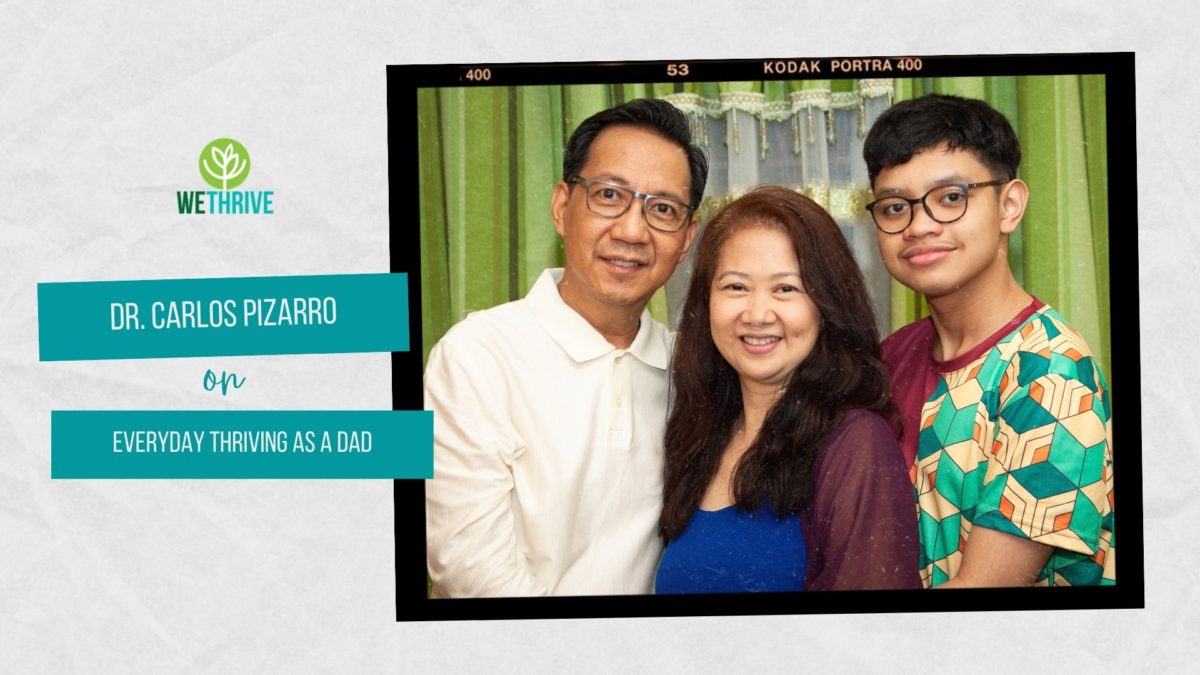
This father’s day, we want to share some insights from one renaissance dad–our very own Dr. Carlos Pizarro.

Dr. Carlos has an established career as a dentist and a mental health clinician. Outside of work, Dr. Carlos is a family man, an active leader in church and non-profit organizations and he is also a musician. Learn more from his insights on fatherhood, self-care and skills for everyday thriving:

What are your practices for Everyday Thriving?

We Thrive celebrates all the men in our lives wearing different hats, our first superheroes, and guides, this day is for you. Happy Father’s Day!

Sources:

American Psychological Association. (2009, September 8). The changing role of the modern day father. http://www.apa.org/pi/families/resources/changing-father

Stambor, Z. (2005, December). Meet the renaissance dad. Monitor on Psychology36(11). http://www.apa.org/monitor/dec05/renaissance

Hazlegreaves, S. (2020, February 19). Why mental health for modern day dads is a hidden but fast-growing issue. Open Access Government. https://www.openaccessgovernment.org/mental-health-for-modern-day-dads/82686/

Categories
Blog Everyday Thriving News & Events Wellbeing Practices

The ABC’s of Resilience

Last month, Dr. Joanna Herrera delivered the commencement address for
Miriam College Middle School, where she shared key insights on building resilience with the graduating 7th graders.

Here is an excerpt of that address, highlighting the ABC’s of Resilience:

“You’ve probably heard the word resilience many times over the course of the pandemic. We are told that we need to develop our resilience. Resilience means the ability to bounce back from difficulties—like when you drop a ball on the ground, and it comes right back up instead of staying on the ground. How do we become resilient? The good news is that neuroscientists tell us that we can train our brains, our minds, to be resilient. If we practice resilience, it grows stronger and becomes part of who we are. So, let’s get to our ABC’s of resilience. 

The A of resilience is Awareness and Acceptance.

We talked about all those big feelings we’re having about the pandemic. We need to turn to our feelings with awareness and acceptance. Not pushing our feelings away, not blaming ourselves for having feelings, not being harsh to ourselves when we’re not feeling ok.

Resilience is not about feeling ok all the time. It’s more about being aware of our internal weather patterns—our moods and emotions and being compassionate to ourselves.

We can say to ourselves, I hear you my sadness, I hear you my boredom, I hear you my fear…let me take care of you. We might want to give our feelings some soothing breaths, in and out. Our breath is a powerful tool for calming feelings. When our feelings are calm, we can think more clearly and make better choices. And perhaps we can reach out to our parents, family members, friends and tell them about how we feel so we are not alone with our emotions.  

The B of resilience is Building Competency.

Awareness allows us to see where we are. Building competency means strengthening our muscles—that is mentally and psychologically, to adopt a mindset and perspective that help us grow. I have a favorite quote from Jon Kabat-Zinn, a famous Mindfulness teacher. He said,

We can’t stop the waves, but we can learn how to surf.

Many times, we are not in control of situations that come up in our lives, big situations just like this pandemic, or everyday things, like getting through schoolwork. But we have a choice to get on our surfboard and not drown. Adopting a growth mindset is an important competency for resilience. Growth mindset means, changing how we talk to ourselves when we make mistakes or face challenges. Instead of saying to ourselves, “I’m not as good as others”, “I won’t try because I might fail”, “I can’t do this, it’s too hard” we can say, “I can learn and practice,” “I will succeed with effort and finding the right strategy,” “If I fail, I can try again until I make it.” People who learn to talk to themselves in this way, become more successful in accomplishing their goals in life. Start practicing now. When negativity arises, open the door of possibility. Your mind has the power to change reality when you choose the right angle to see things from—that is the angle of growth and possibility. Lastly,

The C of resilience stands for Connection.

Strong connections with our friends, our families, our teachers, and even our human family around the world is so essential to our wellbeing. We as human beings are wired to connect, to empathize, to care. While this is a time for physical distancing, it is not a time for social distancing. On the other hand, it is a time for presence and compassion, making each other feel we are here, and we are together. Reach out for support when you’re feeling lonely. Make it a habit to have meaningful connections everyday with your family by putting your gadgets aside during mealtimes and be 100% present. Reach out to your friends who you think might be having a hard time, listen and simply be there.

When we feel connected with one another, we feel safe, calm, and collected. 

We can also practice connecting with our goals and our sense of purpose and take small actions to contribute to the greater good—it can be cheering up a friend, helping with chores at home, baking treats for your grandparents, offering a prayer for those who are sick.

Your small actions can have big impact. Do not underestimate your power to make this world a better place.  

As Dr. Jabby emphasized in her commencement address, resilience is a skill that can be learned and practiced. Want to learn more about resilience and other wellbeing practices? Reach out so we can help get you started.

Categories
General

PEACE Be With You: How to Skillfully Navigate Through the Pandemic

With the onslaught of mostly distressing news about the COVID-19 pandemic,

it is natural to find it challenging to relax and keep calm. Fear and anxiety can get overwhelming amidst the uncertainty and disruption of normal life. To cope, we sometimes tell others and ourselves to “stay calm”. But in times like these, it is understandably easier said than done. This is because calming down takes skills.

The good news is that with practice, skills can be developed and nurtured. The more we use a skill, the more we can master it.

In Space Calm, a mindfulness-based group program for children and teens, participants learn specific life skills they can use to cope with strong emotions such as anxiety, fear, anger, sadness, and loneliness. These are the PEACE skills: Presence, Emotional awareness and understanding, Acceptance, Compassion, and Engagement with others.

Adults and youth alike can benefit from practicing these skills during this challenging time. This could even prove to be the best time to build a skill or two, as you would have even more motivation to manage unpleasant emotions. So, take a look and invite your loved ones – both young and old – to join you in practicing and cultivating these skills.

P – Presence

This is the skill of bringing one’s full attention to what is in the moment. This is a key aspect of mindfulness practice. There’s extensive research evidence in the past 40 years of the many benefits of mindfulness on health and wellbeing. For one, mindfulness practice has been shown to increase resilience to stress and burnout. There have also been significant reductions in attention, behavioral, and anger problems, as well as decreased symptoms of depression and anxiety among youth who practiced mindfulness.

Cultivate the skill:

  1. Five senses – Our senses are the entry point to the present moment. Pause and, without judgment or evaluation, simply notice: 5 things you see; 4 things you can feel on your skin; 3 things you can hear; 2 things you can smell; and 1 thing you can taste at this precise moment in time. (This can be fun to do with others. Take turns in sharing what you’ve become aware of through your senses.)
  2. Mindful activity of daily living – Choose one daily activity that you intend to do mindfully everyday during the week (e.g., brushing your teeth, eating breakfast, combing your hair, taking a shower, etc.). Every time you do this routine activity, focus your full attention on it. If you get distracted, notice what distracted you and then gently bring your attention back to what you are doing. Notice the body sensations and emotions you feel during this “simple awareness” exercise.
  3. Mindful eating – Choose a small piece of food to eat mindfully (examples: a raisin, a bite-sized chocolate, or a small piece of cookie) and place it on your palm. Focus on it and observe its shape, color/s, and other details you can see. Pay attention to how it feels on your skin; turn it over or around slowly and notice its texture. Slowly put it close to your nose and savor its smell. Place it gently inside your mouth and let it sit on your tongue for a while. Notice what’s happening inside your mouth. Savor the taste that’s coming out from this small piece of food. Then, move it with your tongue and slowly bite it with your teeth. Notice the flavors oozing from it. As you swallow slowly, let your attention dwell on your throat and the sensations you feel there. Once you’re done, take a few moments to observe how you feel.
    (You may also check out this video of children demonstrating how to eat more mindfully)

E – Emotional awareness and understanding

This is the capacity to be aware of emotions and be comfortable with any emotion without needing to avoid it or indulge it. This skill allows individuals to calmly recognize emotions with openness and curiosity, with the wise understanding that emotions come and go. 

Cultivate the skill:

  1. Name the emotion – Take several pauses a day to check what emotions are there in the moment. Recognize each one. Still yourself when you feel the need to push a feeling away. Allow yourself to sit with the emotions for a minute or two.
  2. Feel the emotion – Check where in your body you feel the emotion. For instance, where do you feel the anxiety – your head, chest, or tummy? Focus on the body sensation for a minute.
  3. Draw the emotion – Draw an image to represent what you are currently feeling. For those of you who have kids, invite them to do this with you. Then, take turns in talking about the emotion. You can even make it a game and guess what emotion each image represents! (Just one rule: No one makes a judgment about the person or the emotion being felt.)

A – Acceptance

This is the skill of being at peace with what is being experienced in the moment. When we resist what is (e.g., fear, sickness, boredom, etc.), we create more suffering because fighting what is in the here and now is a losing battle. (It is already here!)

Suffering equals pain times resistance.”

Shinzen Young, a mindfulness teacher and neuroscience research consultant

What creates the suffering is the thought that the pain, discomfort, or unpleasant emotion shouldn’t be here (i.e., non-acceptance of what’s here). 

Cultivate the skill:

  1. Smile at it – List down 5 things you’re struggling to be at peace with. Rank them from smallest to biggest struggle. Starting with your smallest struggle, experience the pain or discomfort, feel it in your body as much as you can, but this time, imagine yourself smiling at it. Then, let your lips curve into an actual smile. Smile at the pain or discomfort like it’s your friend. Repeat this exercise, over a few days if needed, until you feel you’ve fully accepted and befriended it. Then, move to the 2nd smallest struggle and so on.
  2. Accepting hands – When you catch yourself resisting what’s in the moment, take time to pause for 1-2 minutes and sit in a comfortable position. You may close your eyes or lower your gaze. Put your hands on your lap with the palms up and fingers relaxed. Feel your body accepting what’s in the moment through your hands. (For instance, if you find yourself worrying and wanting to push away the worry, practice accepting the reality that you feel worried with accepting hands.)

** These exercises make use of the body-mind connection by having your body communicate to your brain.

C – Compassion

This is the capacity of sensing others’ and our own pain and suffering and taking an action to ease away this suffering. Scientific evidence has shown that feeling loved (in contrast to feeling unloved) and being loving (in contrast to being indifferent) helps develop optimal human functioning in relation to stress hormones, immune system functioning, frontal cortical processing, creativity, and the capacity for happiness

Paul Gilbert, Chapter 7, Compassion: Bridging Practice and Science 

Cultivate the skill:

  1. Compassion in action for self – Purposefully and mindfully do one kind thing for yourself each day. Examples: eat a healthy snack, do yoga, or have a relaxing bath. You probably do such things already but the key here is being intentional in giving love and being kind to you.
  2. Compassion in action for others – Purposefully and mindfully do one kind thing for another person each day. Examples: send a sweet note to a family member or a friend, share your food to someone who’s hungry, or massage your mom’s back.
  3. Loving-kindness meditation – This meditation aims to foster feelings of goodwill, kindness, and warmth towards others and self. Here are a few suggested resources:

E – Engagement with others

The skill of engagement refers to one’s ability to relate and interact with others effectively by being curious, attuned, respectful, and empathic (CARE). Social connection is a basic human need. Our brains are wired to connect with one another.

Our capacity to reach out, connect, and interact with others ensures the survival and reproduction of our specie. Social isolation, or lack of social connectedness, has been linked to health risks.

Matthew D. Lieberman (author of Social: Why Our Brains are Wired to Connect)

Thus, effective engagement with others is an essential skill to learn. With this skill, you can make more meaningful relationships with others, lessen conflicts and misunderstandings, and work with others in a peaceful way.

Cultivate the skill:

Choose a person you haven’t paid much attention to or you find difficult to relate with. Practice the skill of engagement by demonstrating CARE every time you talk to him or her. Notice what’s different this time in your engagement compared to before.

  1. Curiosity – Take a not-knowing stance and an active interest in the other person.
  2. Attuned communication – As you talk, listen deeply to yourself and the other (What do I feel and want? What does he/she feel and want?). Communicate clearly and kindly (How can I be kind to myself and the other person while I communicate what I feel and want?).
  3. Respect – Mindfully act in a way that shows the other you care about his/her feelings and wellbeing.
  4. Empathy – Open your heart and mind to sense and understand what the other is experiencing.

Here’s a summary of the PEACE skills and ways to cultivate them:

Practice Exercises
P
Presence
Paying attention to what’s in the moment1. Five senses
2. Mindful activity of daily living
3. Mindful eating
E
Emotional awareness and understanding
Being aware of emotions as they arise and understanding that emotions come and go1. Name the emotion
2. Feel the emotion
3. Draw the emotion
A
Acceptance
Being at peace with what is here and now1. Smile at it
2. Accepting hands
C
Compassion
Sensing and easing away the suffering of self and others1. Compassion in action for self
2. Compassion in action for others
3. Loving-kindness meditation
E
Engagement
Engaging with others in a curious, attuned, respectful, and empathic way (CARE)1. Curiosity
2. Attuned communication
3. Respect
4. Empathy

With practice, we can become skillful in coping with uncertainties and difficulties. We can become PEACEful.

May PEACE be with you!

Categories
Blog Mindful Self-Compassion (MSC)

How does operational air traffic control relate to mindfulness?

The majority of you are most likely thinking “not at all.”

Having worked as an operational air traffic controller at a high-density facility for 40 years+ I’ll nevertheless reveal there is most likely a relationship if you are willing to cut mindfulness down to, for example “focus and concentration”.

Being an outspoken advocate for mindfulness and self-compassion, I decided to discover if a program targeted at this specific audience would have an effect on dropouts. In particular I was curious if trainees within this domain might benefit from training focused at lowering their self- criticism.

I left the operational environment a couple of years ago. Teaching mindfulness of various kinds to operational air traffic control personnel, health care staff as well as to those suffering from chronic pain is what I now focus on.

For quite some time during the 40 years+ in air traffic control I was part of the team recruiting trainees, later I became Head of Training.
So, I have insight to what is required from the trainees and what the typical obstacles are while going through training.

I was fortunate to start collaboration with a private training institute which offers ab initio as well as refresher and continuation training to national and international customers, GATE Aviation Training, in Copenhagen.

The signature of all training at GATE is first and foremost devoted to excellence within training. But it struck me to realize they in fact dare to challenge the educational culture in their form of training methods.

Having known the industry for as long as I have, I knew a door might open for me to try out a program targeted at what I know is of utmost relevance; focus and concentration.

Thanks to Dr. Steve Hickman, Executive Director, The Center for Mindful Self-Compassion, for granting me the permission to deviate from a standard SC-MSC. With Steve’s encouragement the door became open for me to write the curriculum. “FoCon – The Resilient Personnel” became the program’s title.

Session 1 was 90 min., the remaining 6 sessions were all 75 min.

From the onset it was my intention to follow the SC-MSC curriculum with only a few variations of which one would be a body scan as an add on to each session. Along the way real life for “FoCon” turned out to be a lot more than only a few variations.

I started off with what is in fact comparable to an introductory session of the 8-week MSC. I.e., general “house rules & guidelines” for our next many hours together, “How do I treat a friend-exercise,” the felt experience of mindfulness, common humanity and kindness and “Self- Compassion in Daily Life.”

But my point of departure for the unusual training became the UN 17 Goals for Sustainable Development, more specifically goal no. 3 about good health and wellbeing.

Way down in that paragraph it’s mentioned that before 2030 well-being must be promoted.

They just don’t come up with any definitions of what’s included in mental well-being, let alone methods of measuring improvements.

So, with what I took as a free ticket to elaborate further, I included how the mindfulness movement, and later the compassion movement too, for more than 30 years has proven to:

  • enhance general well-being
  • lower blood pressure
  • improve quality of sleep
  • lessen chronic pain, anxiety and stress and more
  • overall increase life satisfaction through fostering happiness

I mentioned a few of the scientific studies to back up the statements.

This is undoubtedly the first time ever any Air Traffic Control Training facility has had mindfulness and compassion training on the agenda with the sole purpose of enhancing focus and concentration.

By including the UN 17 Goals for Sustainable Development, everyone, including management who were present at the intro session, appeared to realize “Ah ha, we’re really among the forerunners for doing something big here!”

So, from there on the path of the course really turned into Hanne paving the road ahead of each session, looking at what do the students really need right now?

I started off with the “Compassionate Body Scan” but after just 2 sessions, I shifted to the body scan we use in the MBSR program.

Some other exercises I included were “Soothing Touch,” “Self-Compassion Break,” “The STOP-Practice,” “Soles of the Feet,” “Soften – Soothe – Allow,” “Compassionate Friend,” “Self-Compassion Stone,” and finally “Setting an Intention”.

All in all, “FoCon” has been a valuable process for trainees as well as for me being the facilitator.

I do think it’s very noteworthy that by the time they received their first progress report, i.e., after “FoCon” Session 4, one third of the trainees said they experienced enhanced concentration capabilities when studying for their exams.

After “FoCon” Session 6 half of the trainees said they felt generally lighter, less stressed when they were in the simulator and felt more overall happiness.

A formal feedback survey was carried out by completion of the “FoCon” program.

That gave me insight to what the trainees actually felt they benefited from most. It didn’t come in as a surprise the body scan was their high time favorite.

“Is “FoCon” something you’ll recommend GATE to have as part of our future training programs?”

On a scale 1 – 5, 5 being the best, the question scored 4.8.

So yes, I firmly believe GATE is among the forerunners offering “FoCon – The Resilient Personnel” as part of their training.

The course has proven to induce trainees with a dose of confidence: YES, I can complete my simulator and on the job training because I have learned I don’t need to bully myself with self- criticism.

For the first time ever, we will be fostering a new generation of personnel for the aviation industry who are being trained to motivate themselves with encouragement rather than criticism and to tackle stressful situations with greater ease.

When a student learns how to soften the inner critic, a successful outcome of training is more likely to become the result.

Learn more about mindfulness and register for our upcoming eight-week Mindful Self-Compassion online course here.

Resources:

Hanne Vedsted-Hansen: info@hannevedsted.dk www.hannevedsted.dk GATE Aviation Training, Copenhagen, Denmark
The Center for Mindful Self-Compassion: